HTTP 2
HTTP/2 can make our applications faster, simpler, and more robust.
Goals
The primary goals for HTTP/2 are to:
- 🔄 Reduce latency by enabling full request and response multiplexing.
- 🗜️ Minimize protocol overhead via efficient compression of HTTP header fields.
- 🚑️ Request prioritization
- 🌐 Server push
HTTP/2 does not modify the application semantics of HTTP in any way. All the core concepts, such as HTTP methods, status codes, URIs, and header fields, remain in place.
🎞️ Instead, HTTP/2 modifies how the data is formatted and transported between the client and server. New Binary Framing Layer
Binary Framing Layer
🔄 Request and Response Multiplexing
With HTTP/1.1, if the client wants to make multiple parallel requests to improve performance, then multiple TCP connections must be used. This workaround was applied because of the HTTP/1.1 delivery model 🚚, which ensures that only one response can be delivered at a time (response queuing [🚶🚶🚶🚶]) per connection. This delivery model also results in 🚧 head-of-line blocking and inefficient use of the underlying TCP connection (cuz multiple connections are used).
🎞️ The new binary framing layer in HTTP/2 removes these limitations 💩, and enables full request and response multiplexing, by allowing the client and server to:
- ✂️ break down an HTTP message into independent frames
- interleave them
- 🗃️ reassemble them on the other end
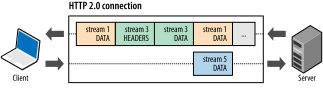
The above image captures multiple streams within the same connection:
- The client is transmitting a DATA frame to the server
- The server is transmitting an interleaved sequence of frames to the client.